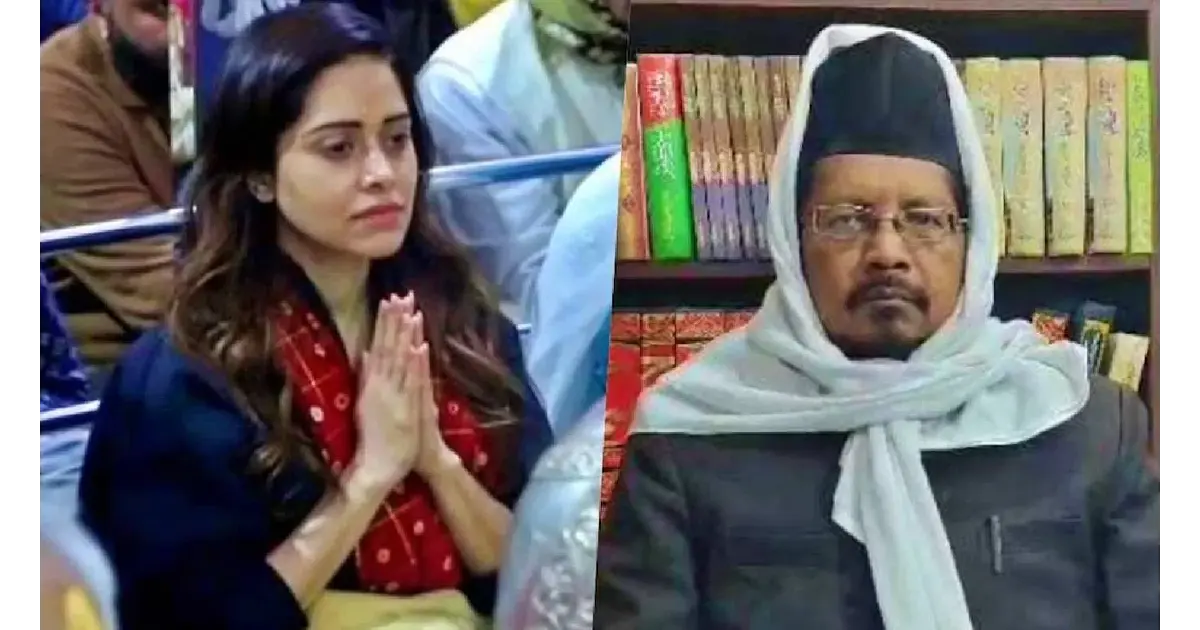
Bollywood actress Nusrat Bharucha has recently become the center of a heated discussion following her visit to the Mahakal Temple in Ujjain, Madhya Pradesh, just before the start of 2026. The visit, captured on video, has quickly gone viral, attracting both admiration and criticism.
Viral Video at Mahakal Temple
The actress was spotted participating in the early morning Bhasma Aarti at Mahakal Temple. The video, shared by news agency ANI, shows Nusrat fully engaged in the ritual at 4 a.m. After the ceremony, temple priests honored her with a shawl, highlighting the cultural and religious significance of her visit.
While many appreciated her gesture as a symbol of religious tolerance, some questioned whether her participation aligned with her Muslim faith.
Religious Leaders React
The visit drew strong criticism from Maulana Shahabuddin Razvi Barelvi, who labeled Nusrat’s actions as a “grave sin.” According to him, applying sandalwood paste and performing Hindu rituals is prohibited under Sharia law. He urged the actress to repent and recite the Kalma, emphasizing that such practices are inconsistent with Islamic teachings.
Similarly, the national president of the All India Muslim Jamaat supported this view, warning that participation in non-Islamic worship could be seen as contrary to Islamic principles.
Nusrat Bharucha on Faith and Spirituality
Despite the backlash, Nusrat has previously shared her views on spirituality and personal faith. In an interview on Shubhankar Mishra’s podcast, she explained:
“Wherever you find peace—whether it’s a temple, a gurudwara, or a church—you should go there. I pray five times a day and carry my prayer mat while traveling. God is one, and we connect with Him through different paths. I want to explore each path and find tranquility wherever I go.”
Her comments underscore her belief in unity across religions and a personal approach to spirituality that transcends traditional boundaries.
Public Discussion and Debate
The incident has sparked widespread debate on social media. Some applaud Nusrat’s open-minded approach to spirituality, while others insist that religious boundaries should be respected strictly. This controversy highlights the complex interplay between personal beliefs, public perception, and societal expectations in India’s diverse religious landscape.
About the Author