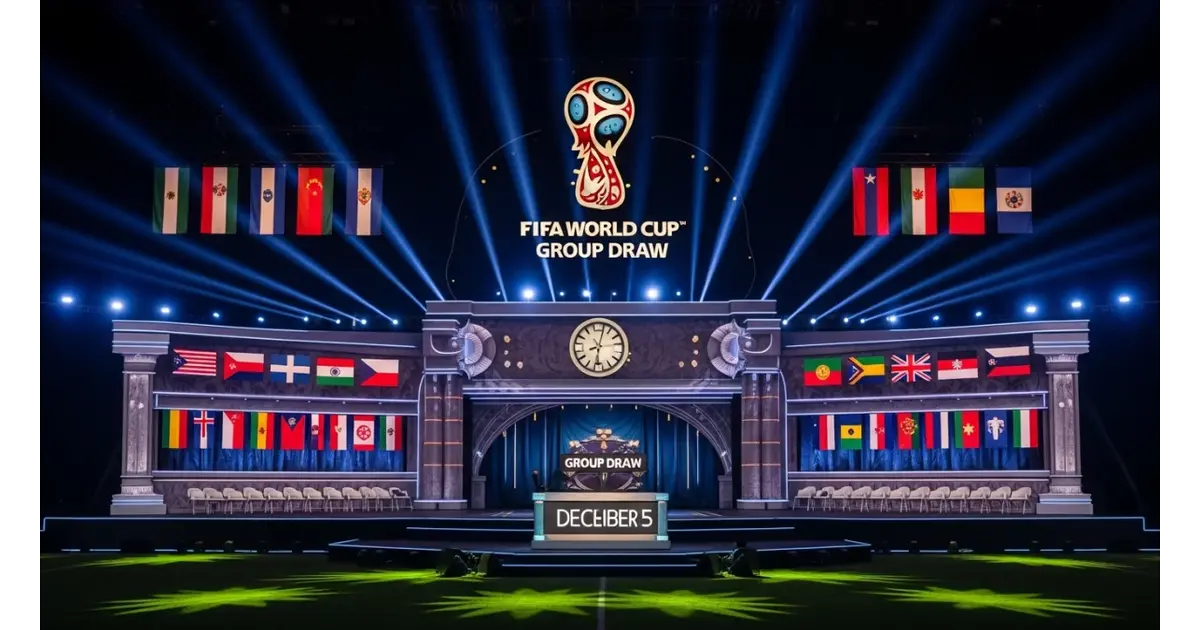
The draw for the expanded 48-team 2026 FIFA World Cup unfolded Friday at the Kennedy Centre, unveiling a series of compelling group-stage matchups and reigniting historic rivalries. Reigning champions Argentina, along with top contenders Spain and England, received favorable draws that could pave the way for strong campaigns.
The event, attended by U.S. President Donald Trump, Mexico’s President Claudia Sheinbaum, and Canadian Prime Minister Mark Carney, marked a key milestone in preparations for the first-ever World Cup co-hosted by three nations. This edition will feature 12 groups of four teams, welcoming a record number of participants to the global tournament.
Hosts and Heavyweights: Group Highlights
Mexico in Group A
Co-host Mexico was placed in Group A alongside South Korea, South Africa, and the UEFA Playoff D winner. The opening match will take place at the newly renovated Estadio Azteca, closed since May 2024 for upgrades. This draw also revives World Cup memories: Mexico and South Africa previously faced off in a 1-1 draw during the 2010 tournament opener.
Canada in Group B
Canada, hosting matches in Vancouver and Toronto, joins Group B with Switzerland, Qatar, and a UEFA playoff entrant. If Italy secures a playoff spot, it will also be part of this group, opening against Canada. Italy, absent from the last two tournaments, may find this a promising route to the knockout stage.
United States in Group D
The United States was drawn in Group D with Australia, Paraguay, and a UEFA playoff qualifier. The U.S. will play home matches, including an early clash with Paraguay in Los Angeles. One of Europe’s final entrants from Pot 4 will also join this group.
Brazil and Scotland: A Reunion in Group C
Five-time champions Brazil headline Group C alongside Morocco, Scotland, and Haiti. This group brings back a historic pairing from 1998 — the last World Cup Scotland qualified for. The Tartan Army faces another challenging campaign, having never advanced beyond the group stage.
Brazil’s second match will be against Haiti, echoing their 2004 “Game of Peace” friendly in Port-au-Prince, which ended 6-0 in Brazil’s favor. With a Haitian community of roughly 150,000–200,000 in Brazil, the fixture carries cultural significance as well.
European Giants Spread Across the Draw
Germany will compete in Group E with Ecuador, Ivory Coast, and Curaçao, while the Netherlands joins Group F with Japan and Tunisia. England was drawn into Group L alongside Croatia and Panama — a rematch of their 2018 semifinal — with Ghana completing the group.
Spain and Uruguay, both former champions, headline Group H, considered one of the toughest groups. France is in Group I with Senegal and Norway, opening against Senegal in a repeat of their memorable 2002 World Cup clash where the African side stunned the defending champions 1-0.
South American Powerhouses: Strong Prospects
Argentina leads Group J with Algeria, Austria, and Jordan. Portugal heads Group K with Colombia and Uzbekistan, with the final spot determined by one of FIFA’s intercontinental qualifiers. Belgium takes the lead in Group G, joined by Iran, Egypt, and New Zealand. Iran faces travel challenges due to U.S. restrictions, as Group G matches will take place in Seattle and Inglewood.
Revived Rivalries and Logistical Challenges
Morocco, 2022 semifinalists, will face Brazil in one of the most high-profile group-stage fixtures. Depending on results, France and Germany could meet in the round of 16, potentially revisiting their famous 1982 semifinal showdown.
The draw also presents logistical challenges, with England potentially playing two matches in Vancouver, and co-hosts Canada and the U.S. seeing group-stage games spread across multiple cities. FIFA will release the complete match schedule on Saturday, finalizing venues and kickoff times for the biggest World Cup in history.
Related posts:
Mohammed Shami was thinking of committing suicide, revelation created a stir
2026 Men’s T20 World Cup: Key Details and Schedule
Nitish Kumar Reddy: The Rise of a Modern Cricket Star
Cricketer Sarfaraz Khan Emotional Moment with Parents
Sanju Samson: Rising Amid India’s Top-Order Woes
Virat Kohli Struggles Continue in Australia ODI Series
About the Author