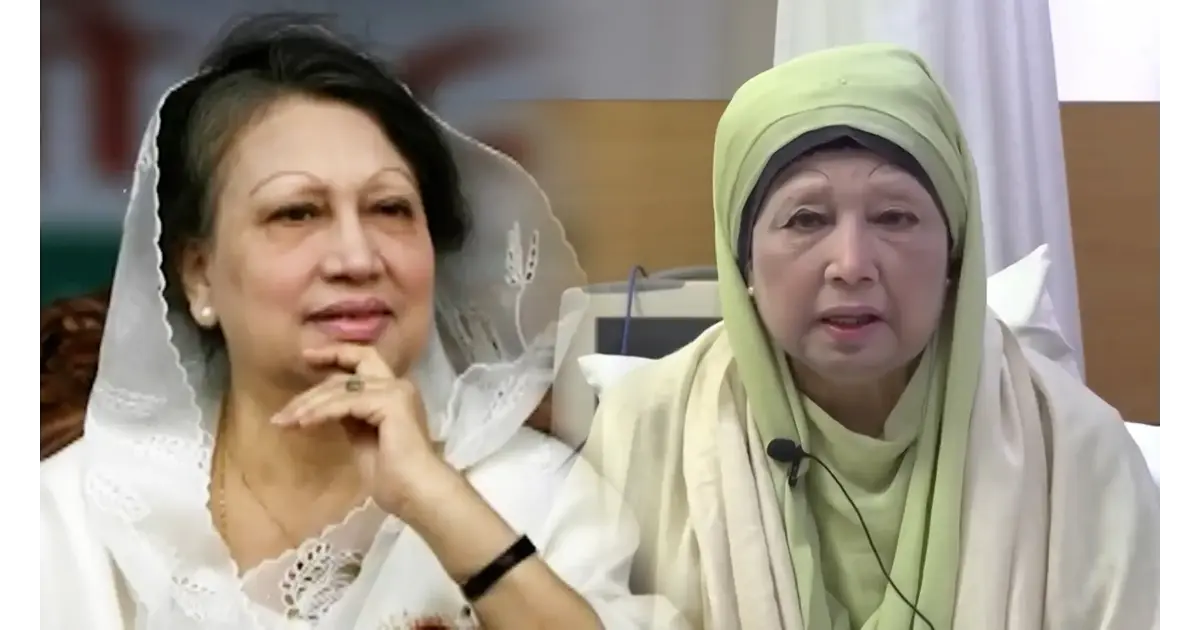
Bangladesh lost a towering political figure on Tuesday, as former Prime Minister Begum Khaleda Zia passed away at the age of 80. Zia, the chairperson of the Bangladesh Nationalist Party (BNP), died after a prolonged illness while receiving treatment at Evercare Hospital in Dhaka.
Final Days and Health Struggles
Zia had been under medical care for 36 days since November 23, battling infections in her heart and lungs, as well as pneumonia. She faced multiple chronic health conditions over the years, including:
- Liver cirrhosis
- Arthritis
- Diabetes
- Chronic issues with kidneys, lungs, heart, and eyes
Her treatment involved specialists from Bangladesh, the UK, US, China, and Australia. Earlier attempts to take her abroad for further care were canceled due to her fragile condition.
Zia is survived by her elder son Tarique Rahman, his wife Zubaida Rahman, and their daughter Zaima Rahman. Her younger son, Arafat Rahman Koko, had passed away in Malaysia.
Political Legacy and Achievements
Begum Khaleda Zia made history as Bangladesh’s first female prime minister, serving three terms. Her political career formally began after the assassination of her husband, Ziaur Rahman, founder of the BNP, in 1981.
Key highlights of her career include:
- Vice-President of BNP (1984) and later Chairperson
- Collaboration with Sheikh Hasina to restore democracy in 1990
- Introduction of parliamentary democracy and the caretaker government system
- First term as Prime Minister following the 1991 elections
- Leadership during a turbulent era of political rivalries and Islamist militancy
Her tenure saw major reforms, but it was also marked by controversy, allegations of corruption, and political feuds, most notably with Awami League leader Sheikh Hasina. The rivalry between the two women earned them the nickname “the battling Begums.”
Major Political Challenges
Zia’s second term (1996–2001) faced challenges such as:
- Rising Islamist militancy
- The 2004 grenade attack on Sheikh Hasina, resulting in deaths and injuries
- Allegations of corruption and misuse of power
She was jailed in 2018 for alleged embezzlement but moved to house arrest in 2020 due to deteriorating health. In 2024 and 2025, Bangladesh’s Supreme Court acquitted her and her son Tarique Rahman in major corruption and attack-related cases.
Early Life and Personal Background
Born in 1945 in Jalpaiguri, British India, Zia’s family migrated to Dinajpur, East Bengal, after the partition. She married Ziaur Rahman in 1960 and was nicknamed “Putul” in her family.
Her educational journey included:
- Dinajpur Missionary School
- Dinajpur Girls’ School (matriculation, 1960)
- Surendranath College of Dinajpur
During the Bangladesh Liberation War in 1971, Ziaur Rahman fought for independence. After his assassination in 1981, Khaleda Zia took the reins of BNP, entering politics for the first time.
Enduring Influence
Despite political ups and downs, house arrests, and legal challenges, Khaleda Zia remained a symbol of female leadership and political resilience in Bangladesh. Her long-standing rivalry with Sheikh Hasina shaped the nation’s political landscape for decades, influencing governance, elections, and public policy.
Her passing marks the end of an era for Bangladesh, leaving behind a complex legacy of reform, political struggle, and leadership in a male-dominated landscape.
About the Author