Veteran Writer’s Remarks Gain Fresh Attention
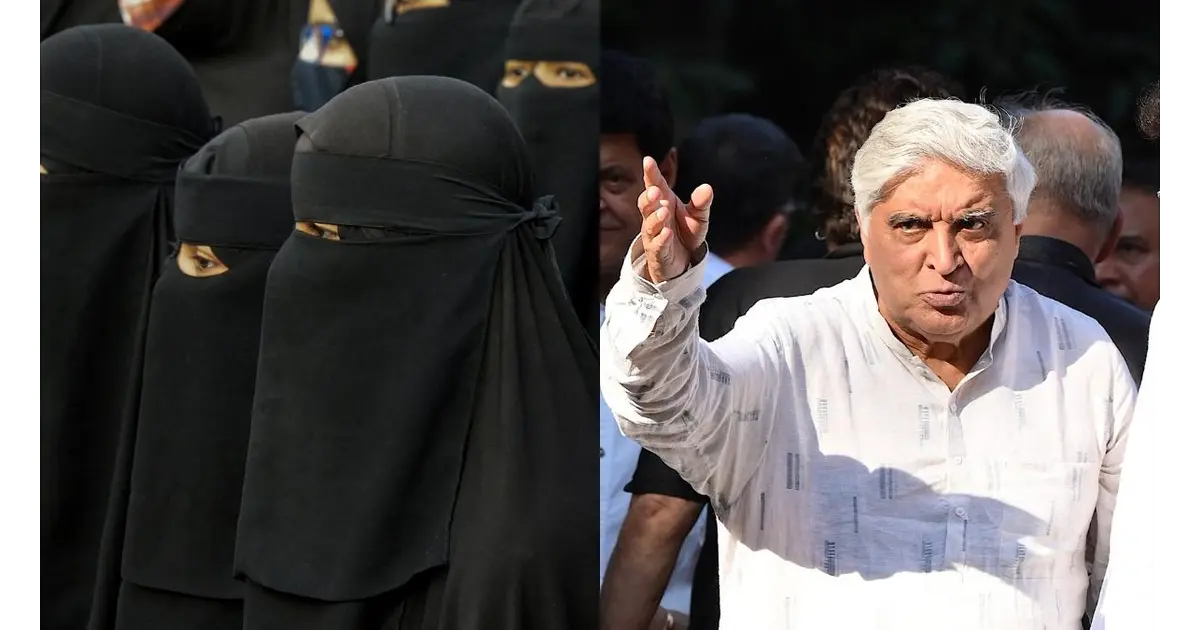
Renowned lyricist and screenwriter Javed Akhtar recently found himself at the center of an intense public discussion after speaking candidly about burqa, religion, and social conditioning. His comments, made during the SOA Literary Festival 2025, resurfaced online and quickly went viral amid an ongoing controversy involving Bihar Chief Minister Nitish Kumar and a Muslim woman doctor’s hijab. The renewed attention has placed Akhtar’s views on women’s autonomy and societal expectations under the spotlight.
Questioning the Logic Behind Face Covering
At the literary festival, Javed Akhtar addressed a student’s question about his earlier statement that he was raised by women who did not wear burqas. Responding openly, he challenged the idea that a woman’s face needs to be hidden. “Why should a woman be ashamed of her face?” he asked, questioning what could possibly be considered vulgar, undignified, or inappropriate about a woman’s face that it must be covered. According to Akhtar, while modest dressing applies equally to men and women, face covering goes beyond decency and enters the realm of social enforcement.
Distinguishing Faith from Social Conditioning
Careful not to attack personal belief or religious faith, Akhtar emphasized that his criticism was directed at societal norms rather than individual choices. He described the practice of face covering as a result of deep-rooted social conditioning, arguing that many women adopt it due to invisible pressure rather than genuine personal freedom. He suggested that appreciation or approval from peers often plays a strong role in shaping such decisions, even when they are presented as voluntary.
Is It Really a Personal Choice?
Expanding on his argument, Akhtar questioned whether face covering would exist in the absence of social pressure. He asked why anyone would feel the need to hide their face if they were truly free from judgment or expectation. His remarks framed the issue as one of autonomy versus conformity, urging people to reflect on whether long-standing customs still serve a meaningful purpose in modern society.
Nitish Kumar Hijab Controversy Adds Fuel to the Fire
The debate intensified after Bihar Chief Minister Nitish Kumar was criticized for pulling down the hijab of a newly appointed AYUSH doctor during a public event. The incident drew sharp condemnation from opposition leaders and civil society, who questioned the appropriateness of his conduct and raised concerns about respect and personal boundaries.
Akhtar Condemns the Chief Minister’s Actions
Following the viral spread of his festival remarks, Javed Akhtar issued a clarification on X, formerly Twitter. While reiterating his opposition to the traditional concept of parda, he strongly condemned Nitish Kumar’s behavior, calling it unacceptable and disrespectful. Akhtar stated that opposing parda does not justify violating a woman’s dignity and asserted that the chief minister owed the doctor an unconditional apology.
A Conversation That Continues
Javed Akhtar’s comments have reignited a broader national conversation on women’s freedom, cultural practices, and the fine line between choice and coercion. As opinions remain divided, his remarks continue to prompt reflection on how society defines modesty, respect, and individual rights in a changing world.
About the Author