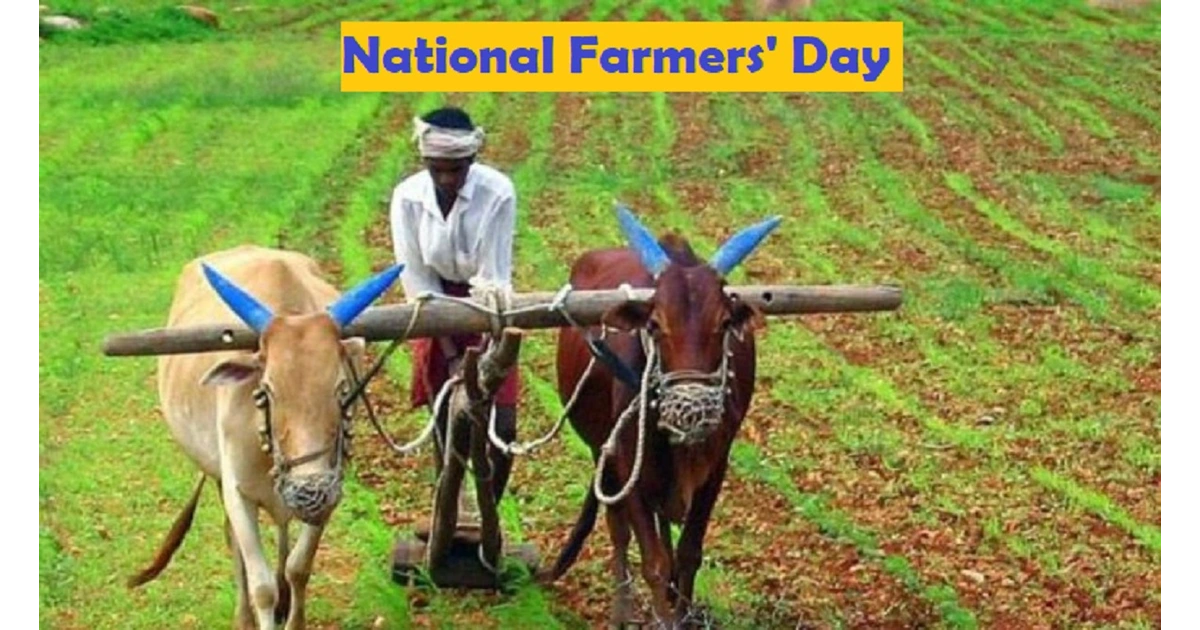
National Farmers Day 2025, widely known as Kisan Diwas, is observed across India on 23 December each year to recognise the indispensable role farmers play in ensuring food security, rural livelihoods, and economic stability. The day commemorates the birth anniversary of Chaudhary Charan Singh, India’s fifth Prime Minister, whose lifelong commitment to agrarian reform and farmer welfare continues to shape the nation’s agricultural vision. National Farmers Day stands as a tribute to the resilience, dedication, and contribution of farmers who form the foundation of India’s development.
Theme of National Farmers Day 2025
The theme for National Farmers Day 2025, “Vikasit Bharat 2047 – The Role of FPOs in Globalising Indian Agriculture,” underlines the transformative potential of Farmer Producer Organisations (FPOs) in modernising Indian agriculture. FPOs enable farmers, particularly small and marginal cultivators, to unite as collectives, strengthening their bargaining power and improving access to technology, quality inputs, institutional finance, and global markets.
By integrating farmers into efficient value chains, promoting agri-exports, and encouraging sustainable and market-oriented farming practices, FPOs play a critical role in making Indian agriculture globally competitive. Their contribution is central to achieving the long-term vision of a developed India by 2047.
History of National Farmers Day
National Farmers Day is observed annually on 23 December to mark the birth anniversary of Chaudhary Charan Singh. The Government of India officially declared this observance in 2001 to honour his immense contribution to agriculture and rural development. Chaudhary Charan Singh is remembered for championing farmers’ rights, leading land reforms, and abolishing the zamindari system that had long exploited cultivators.
The day serves as an opportunity to acknowledge farmers’ contribution to national food security and economic resilience. It also provides a platform for dialogue on agrarian challenges, policy improvements, and farmer-centric welfare initiatives. Across the country, awareness programmes, seminars, and agricultural outreach activities are organised to reinforce the importance of agriculture in India’s overall progress.
Who Was Chaudhary Charan Singh?
Chaudhary Charan Singh was a freedom fighter, distinguished statesman, and visionary agrarian reformer who served as India’s fifth Prime Minister from 1979 to 1980. Born on 23 December 1902 in a farming family in Uttar Pradesh, he developed a deep understanding of rural realities early in life. His political journey was driven by a firm belief that India’s prosperity depended on the well-being of its villages and farmers.
He consistently opposed development models that prioritised urban industrial growth at the expense of agriculture. His policies and writings reflected a strong commitment to land reforms, rural empowerment, and agriculture-led economic development. Due to his unwavering advocacy for farmers, he is widely revered as the “Champion of Farmers” in Indian history.
Contributions of Chaudhary Charan Singh to Indian Agriculture
Chaudhary Charan Singh played a decisive role in implementing zamindari abolition laws in Uttar Pradesh during the 1950s, transferring land ownership to millions of tenant farmers and dismantling feudal agrarian structures. As Revenue Minister and later Chief Minister of Uttar Pradesh, he introduced land ceiling policies that benefited small and marginal farmers.
He authored the influential book India’s Poverty and Its Solution in 1939, where he argued that neglect of agriculture was the primary cause of rural poverty. He strongly opposed excessive urban-industrial bias, emphasising that a majority of India’s population depended on farming. He advocated fair and remunerative crop prices, laying the ideological groundwork for price support mechanisms.
Charan Singh promoted cooperative institutions and institutional rural credit to free farmers from exploitative moneylenders. He believed that a strong village economy was essential for democracy and national stability. Even during his brief tenure as Prime Minister, he prioritised rural development and farmer-oriented governance, ensuring that agrarian issues remained central to national policy.
Significance of National Farmers Day 2025
National Farmers Day 2025 highlights the crucial contribution of farmers to food security, employment generation, and economic sustainability. It draws attention to the fact that agriculture supports nearly half of India’s population, making farmer welfare essential for inclusive growth. The day honours Chaudhary Charan Singh’s vision of agriculture-driven development and renews focus on contemporary challenges such as climate change, rising input costs, and market uncertainties.
It encourages dialogue on farmer-centric reforms, including income security, crop insurance, access to credit, and technological innovation. The observance also promotes sustainable and climate-resilient farming practices while emphasising the growing role of FPOs in improving market access and collective strength. Ultimately, National Farmers Day reinforces the idea that rural prosperity is indispensable to achieving the vision of Vikasit Bharat 2047.
Related posts:
UAE vs US: America won the toss and decided to bowl first, see the playing 11 of both the teams here
Turkey Downs Drones in Black Sea
5 policemen suspended for negligence in Ghaziabad, Bolero written on police record entered the lane ...
Happy Daughter's Day Shayari Wishes
The copy of the first edition of the Constitution of India was auctioned for Rs 48 lakh
Chandigarh Police Achieve Major Breakthrough in Robbery Case
About the Author