Advancing India’s Human Spaceflight Endeavor
The Indian Space Research Organisation (ISRO) has made a significant leap toward its ambitious human spaceflight program, Gaganyaan, by successfully completing a series of critical tests for drogue parachutes. These parachutes are essential components of the crew module’s deceleration system, designed to slow down the spacecraft during its re-entry into Earth’s atmosphere. Gaganyaan aims to send a three-member crew on a three-day journey into space and safely bring them back to Earth.
Testing at the Rail Track Rocket Sled Facility
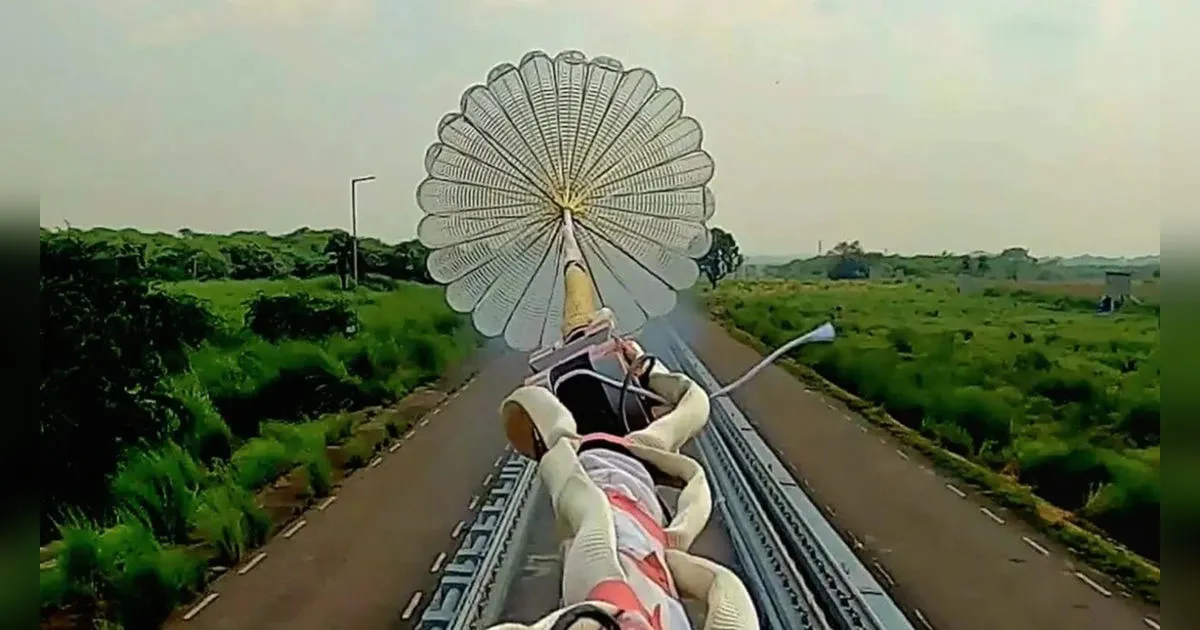
The tests were conducted at the Rail Track Rocket Sled (RTRS) facility of the Defence Research and Development Organisation’s (DRDO) Terminal Ballistics Research Laboratory (TBRL) in Ramgarh, near Chandigarh, between December 18 and 19. The RTRS facility employs rocket-propelled sleds that travel along rail tracks at velocities multiple times the speed of sound, simulating extreme re-entry conditions for the parachute system.
Anatomy of the Gaganyaan Parachute System
The Gaganyaan crew module relies on a sophisticated ten-parachute deceleration system comprising four different types of parachutes:
- Apex Cover Separation Parachutes: Two initial parachutes that remove the protective cover of the parachute compartment.
- Drogue Parachutes: Two parachutes that stabilize and reduce the speed of the crew module.
- Pilot Parachutes: Three parachutes that deploy the main parachutes.
- Main Parachutes: Three parachutes that ensure a controlled and safe landing of the crew module.
Among these, the drogue parachutes are particularly critical, as they stabilize the module and reduce its velocity to a safe level during re-entry.
Objectives and Outcomes of the Tests
The recent series of tests aimed to assess the performance and reliability of the drogue parachutes under extreme conditions. Both tests conducted on the RTRS facility successfully met all objectives, demonstrating the parachutes’ robustness across a range of flight scenarios.
Collaboration Across Agencies
The Terminal Ballistics Research Laboratory (TBRL), which evaluates missiles, warheads, explosives, and other projectiles, worked closely with ISRO’s Human Space Flight Centre (HSFC) to conduct hypervelocity impact studies on the Gaganyaan crew module and other mission-critical components. The successful testing was supported by multiple organizations, including the Vikram Sarabhai Space Centre (VSSC), ISRO, Aerial Delivery Research and Development Establishment (ADRDE), DRDO, and TBRL.
A Step Closer to Human Spaceflight
The successful completion of these drogue parachute tests represents a major milestone in qualifying the parachute system for human spaceflight, bringing India closer to achieving its first manned mission into space.
Related posts:
ITR Deadline Extended to November 30 After Multiple HC Orders
44250 government jobs in two and a half years, 50 jobs given to youth on an average every day in 872...
Zarine Khan Passes Away, Bollywood Pays Tribute
De De Pyaar De 2 Day 1 Box Office: Modest Start for Ajay Devgn
Haryana Election 2024: 45 big rallies in 15 days, Aam Aadmi Party busy preparing for elections in Ha...
Class Over Form: Rohit Sharma Shines in Sydney
About the Author