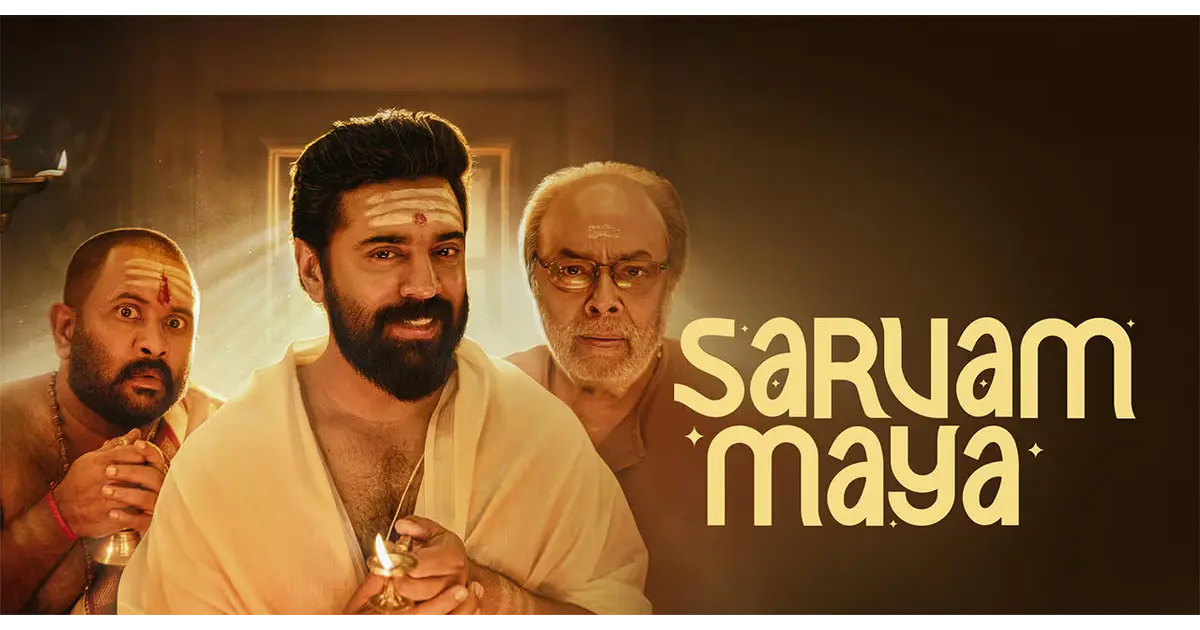
A Gentle World Rooted in Familiar Emotions
Sarvam Maya unfolds with indulgence and quiet warmth, settling into the viewer’s mind long after the screen fades to black. The film feels like a natural extension of what could be called the Sathyan Anthikad school of cinema—stories that Malayali audiences instinctively understand and emotionally inhabit. Moving at an unhurried, everyday rhythm, the narrative opens doors to paddy fields, temple ponds, ancestral homes, and village lanes, capturing gentle humour, family bonds, and human imperfections with affectionate ease. There is a comforting self-awareness to the film, highlighted by the presence of posters from Pachuvum Adbhudha Vilakkum, Varane Avashyamund, and Njan Prakashan within the story world itself, subtly acknowledging the cinematic lineage it belongs to.
Story and Central Conflict
At the heart of Sarvam Maya is Prabhendu, played by Nivin Pauly, an aspiring musician born into a wealthy family of priests. His ordinary life takes an unexpected turn when an unconventional ghost begins following him, setting the foundation for a narrative that blends the supernatural with everyday emotion. Rather than relying on spectacle, the film focuses on how this unusual companionship gently alters Prabhendu’s inner world, allowing humour and feeling to arise organically from the situation.
Performances That Carry the Film
Nivin Pauly appears fully at home in this role, reminding audiences of the ease and charm that once defined his best performances. Under Akhil Sathyan’s direction, his strengths are used effectively, allowing him to inhabit Prabhendu with natural warmth. Riya Shibu is a revelation as the ghost, infusing the character with an endearing innocence that makes her presence both believable and lovable. She shares the emotional weight of the film with confidence, standing shoulder to shoulder with Nivin throughout. At moments, the film briefly recalls the emotional tenderness of Vismayathumbathu, especially in the way the supernatural is treated not as fear, but as intimacy and comfort.
Supporting Cast and Character Dynamics
Aju Varghese, as Prabhendu’s cousin, once again demonstrates his effortless chemistry with Nivin Pauly, delivering a familiar and enjoyable bromance. Preity Mukundan plays Sadiya with sincerity, adding stability to the emotional fabric of the story. Madhu Warrier, cast as the elder brother, brings an unexpected but fitting presence, while Janardhanan’s turn as the uncle evokes a nostalgic echo of his energetic roles from the 1990s. Anand Ekarshi, director of Aattam, appears as Prabhendu’s friend and colleague and makes good use of his substantial screen time with a grounded performance.
Simplicity as the Film’s Strength
Sarvam Maya does not aim for complex symbolism or layered philosophical depth. Its true power lies in its simplicity. The humour is soft, situational, and deeply human, earning gentle laughter rather than loud applause. The storytelling is transparent, allowing viewers to notice the small moments that nudge the plot forward, the gradual shifts in character behaviour, and the careful handling of a premise that could easily have felt awkward or controversial. The film feels considered and sincere in its intent.
Narrative Flow and Emotional High Points
The first half functions as a steady and effective build-up, while the second half, though richer in plot movement, feels slightly stretched. A more even distribution of narrative shifts might have balanced the pacing better. Akhil Sathyan’s indulgent approach is evident, as he allows scenes to breathe and linger before reaching the conclusion. Despite this, the film consistently maintains a soothing tone, leaving viewers with a sense of calm satisfaction. A particularly moving moment arrives towards the end through the brief appearance of Vineeth and Methil Devika. Their restrained reactions deliver a powerful emotional blow, which is then matched by the brother’s response, creating one of the film’s most memorable sequences.
Dialogues, Music, and Overall Texture
The dialogues largely work well, though a few lines lose impact due to uneven delivery. Akhil Sathyan shows a confident grasp of contemporary, Gen Z-inflected language, lending authenticity to the younger characters. The film is populated with numerous characters and cameo appearances; while some enrich the narrative, others feel less essential. Justin Prabhakar’s music remains understated, never demanding attention but blending smoothly with the film’s gentle mood.
About the Author